
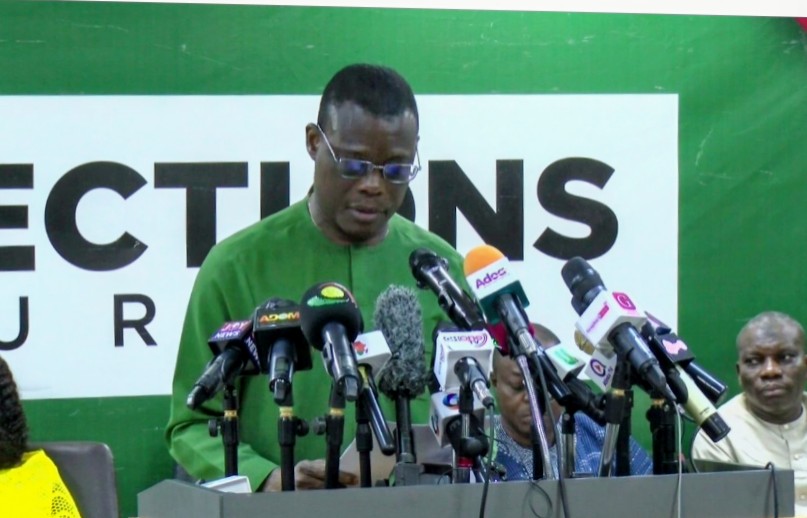
The governing National Democratic Congress (NDC) has officially launched activities for the 2026 NDC Month, with a strong call for national reflection on democratic governance, accountability, and the strengthening of state institutions.
Addressing the media at a pre6ss briefing, the party’s General Secretary, Fifi Fiavi Kwetey, announced that this year’s observance would begin on May 15, describing the date as “a profound historical significance” in Ghana’s political evolution that eventually led to the formation of the Provisional National Defence Council (PNDC) and later the NDC.
According to him, the annual NDC Month serves as a period of “reflection, remembrance, recommitment and renewal” of the ideals upon which the party was founded.
“This year’s theme, ‘Strengthening State Institutions: Lessons from the June 4, 1979 Uprising,’ speaks directly to the current aspirations of our nation and the urgent task of national renewal,” Mr. Kwetey stated.
He explained that the June 4 uprising represented a demand for integrity in public life, accountability in governance, discipline in leadership, social equity and responsible stewardship of state resources.
“The principles of probity, accountability, inclusiveness and people-centered governance, which formed the moral foundation of June 4, are inseparable from the broader national reset agenda currently underway,” he said.
The NDC General Secretary linked the ideals of the June 4 uprising to the government’s ongoing Reset Agenda under President John Dramani Mahama, noting that the initiative seeks to restore confidence in public institutions, rebuild national trust and deepen transparency in governance.

A major highlight of the month-long commemoration will be activities in honour of the late former President Jerry John Rawlings, whom the party described as the founder of the NDC and a key architect of Ghana’s democratic journey.
Mr. Kwetey paid glowing tribute to Rawlings, praising his courage, patriotism and commitment to probity and accountability.
“President Rawlings devoted his life to the empowerment of ordinary Ghanaians, the strengthening of democratic governance and the pursuit of social justice.
His legacy continues to inspire generations within the NDC and beyond,” he noted.
As part of the activities, the NDC will hold a major public lecture in the Banda Constituency on June 3 to discuss the historical impact of the June 4 uprising and the role of state institutions in accountable governance.
On June 4, the party will organize a ceremonial flag raising, wreath laying, lighting of the perpetual flame and a grand durbar involving chiefs and people of the Bono Region to symbolize remembrance, national unity and commitment to democratic accountability.
June 10 will be marked as NDC Day, with programmes aimed at revisiting the ideological foundations of the party and encouraging greater participation of women and youth in democratic governance.
The party will also commemorate Cadres Day in Kumasi on June 19 under the theme, “Ensuring Transparent Governance: The Role of Cadres,” focusing on the responsibility of cadres and activists in safeguarding accountability and national integrity.
The celebrations will climax on June 22 with Founder’s Day activities, including the naming of the party headquarters after former President Rawlings and the unveiling of his bust in honour of his contribution to the establishment and growth of the NDC.
Mr. Kwetey stressed that the events were not merely ceremonial but intended to promote political education, national reflection and patriotic renewal.
“These activities are intended to reconnect, especially the younger generation, to the historical struggles that shaped our democracy and the values that must continue to guide national leadership,” he stated.
He called on party members, cadres, activists, sympathizers and Ghanaians across the country to actively participate in the commemorative activities.
“As a Party founded on the principles of social justice, accountability, probity, and the empowerment of ordinary people, the NDC remains committed to building a stronger Ghana where state institutions work effectively for all citizens and where governance remains transparent, responsive and inclusive,” he added.
Source: Felix NYAABA//expressnewsghana.com