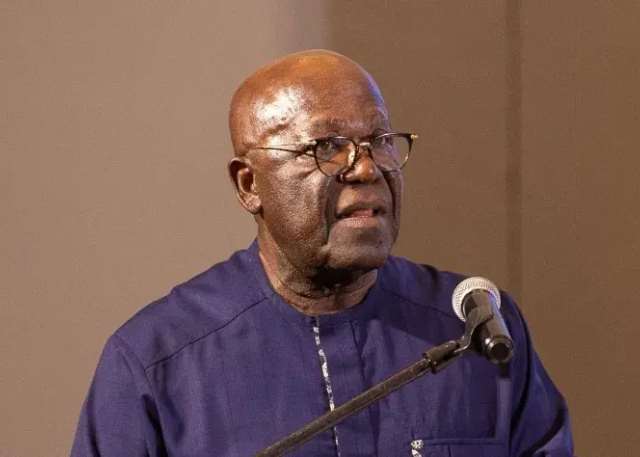
The Ambassadors for Reconciliation, Justice and Peace-Africa (ARJPA) has defended renowned Ghanaian business leader Sir Sam Jonah’s objectivity in his recent lecture on former Head of State General Ignatius Kutu Acheampong, accusing broadcaster Paul Adom-Otchere of misrepresenting its central message through what it describes as selective historical commentary.
In a statement issued by its Founder and President, Rev. Friar Albert Cato Horace Kwesi deGraft-Johnson, OP, ARJPA said the debate surrounding Sir Sam Jonah’s 2nd General I.K. Acheampong Memorial Lecture, delivered on November 13, 2026, should promote historical understanding and national reconciliation rather than partisan arguments.
The statement follows comments made by Mr Adom-Otchere on his television programme, Good Evening Ghana, in which he reportedly suggested that Sir Sam Jonah was advocating the immortalisation of General Acheampong.
ARJPA, however, rejected that interpretation, describing it as a misrepresentation of the lecture and arguing that Mr Adom-Otchere appeared to have relied on hearsay rather than engaging with the full presentation.
The organisation also pointed out what it described as a significant historical error in the commentary, stressing that General Acheampong seized power on January 13, 1972, through a coup that overthrew the civilian government of Dr Kofi Abrefa Busia, and not in 1969.
According to ARJPA, the year 1969 marked the return to civilian constitutional rule, making the reference to that year particularly misleading.
The organisation has consequently called on Mr Adom-Otchere to apologise to his viewers for the historical inaccuracy.
Defending Sir Sam Jonah’s presentation, ARJPA said the renowned businessman approached Acheampong’s leadership with intellectual honesty, acknowledging both the achievements and shortcomings of the former military ruler.
It noted that Sir Sam Jonah did not portray Acheampong as a flawless leader but rather called for an honest examination of his political legacy, including the complexities surrounding his leadership and the controversial Union Government proposal.
“He did not say Acheampong was a saint. He said we must examine him ‘with as much honesty as we can muster,’” the statement emphasised.
ARJPA further observed that Sir Sam Jonah openly acknowledged the personal benefits he derived from Acheampong’s 1972 takeover of Ashanti Goldfields, which, according to the lecture, created opportunities for Ghanaians such as himself.
The organisation described this admission as an indication of the speaker’s willingness to confront history without concealing personal interests or allowing political affiliations to influence his assessment.
It also defended Sir Sam Jonah’s description of Acheampong as an “orphan of Ghana’s politics”, arguing that the former Head of State had been largely abandoned by both the Nkrumahist and Busiaist political traditions.
On Mr Adom-Otchere’s commentary, ARJPA accused him of shifting attention from the central issues raised in the lecture to the political legacy of Dr Busia and the Progress Party tradition.
The organisation described this approach as a form of “polite unfairness”, arguing that although Mr Adom-Otchere did not openly attack Sir Sam Jonah, he allegedly redirected the lecture’s historical argument to advance a different political narrative.
“Sam Jonah said: Let us break the silence on General Acheampong. Paul Adom-Otchere answered: Yes, let us break the silence — and then talk about Busia. That is not a response. That is a diversion,” the statement said.
ARJPA also questioned the broadcaster’s selective presentation of Acheampong’s economic record, arguing that his commentary concentrated on achievements between 1973 and 1977, including rice production, mattresses and beverages, without adequately addressing the economic difficulties that characterised the period.
It cited budget deficits, shortages, inflation, debt repudiation and the eventual execution of Acheampong as issues that should form part of a comprehensive assessment of his administration.
The organisation further challenged attempts to equate Acheampong’s Ghanaization agenda with that of Dr Busia, insisting that the two administrations pursued different economic and political approaches.
According to ARJPA, Busia’s Ghanaization policy was associated with liberalisation and the 1971 currency devaluation, while Acheampong’s approach was linked to Operation Feed Yourself, debt repudiation and a departure from the preceding administration’s liberalisation policies.
It argued that presenting the two approaches as identical risks misleading the public about the distinct historical circumstances and policy choices of the two governments.
At the heart of its concerns, ARJPA said Sir Sam Jonah’s lecture was intended to promote national reconciliation by bringing a controversial and often neglected historical figure into an honest national conversation.
It contrasted this with what it described as an attempt by Mr Adom-Otchere to reclaim the Ghanaization narrative for the Busia-Danquah political tradition.
“Reconciliation says: This belongs to all of us. Reclamation says: This belongs to us, not to him,” the statement declared.
The organisation maintained that Ghana could not achieve genuine national healing if its history continued to be selectively presented to serve the interests of competing political traditions.
It therefore urged Ghanaians to examine the full lecture before forming opinions, while calling on media organisations to exercise greater responsibility in their use of historical footage and political commentary.
“Politeness is not fairness. And clever editing is not history,” ARJPA stated, adding that the country must learn to confront its past honestly rather than replace one historical silence with another.
The organisation concluded by urging Mr Adom-Otchere to apologise for the 1969 historical error and what it described as his reliance on hearsay, while encouraging media houses to avoid using archival footage selectively to score partisan points.
It also called on the public to read or listen to Sir Sam Jonah’s complete lecture to appreciate the context of his arguments.
“History will judge us not by who we praised, but by whether we told the truth,” the statement concluded.
The statement was signed by Rev. Friar Albert Cato Horace Kwesi deGraft-Johnson, OP, Founder and President of the Ambassadors for Reconciliation, Justice and Peace-Africa.
In an accompanying author’s note, Rev. deGraft-Johnson disclosed his descent from Joseph William deGraft-Johnson on his paternal side and John Mensah Sarbah on his maternal side, saying the historical lineage reinforced his organisation’s commitment to national reconciliation rather than allegiance to any particular political tradition.