


UDS: From ‘Knowledge for Service’ to African and World Sporting Glory

There are institutions whose achievements deserve celebration, but there are also institutions whose history, philosophy and impact deserve deeper understanding.
The University for Development Studies (UDS) is one such institution.
Established in 1992, UDS was Ghana’s first public university established in the northern sector of the country. Its creation marked a significant milestone in expanding university education beyond the southern parts of Ghana and bringing higher education closer to communities in the North.
With its roots in Tamale and Nyankpala, UDS was established with a distinctive purpose. Its philosophy was built around “Knowledge for Service”—the idea that education should not remain confined to lecture halls but should be applied to the development needs of communities.
That philosophy has given UDS a distinctive identity
A Different Approach to University Education: UDS developed an educational model designed to connect academic knowledge with practical experience.
While students receive classroom instruction like their counterparts in other universities, the UDS model has traditionally placed considerable emphasis on taking students beyond the classroom and exposing them to the realities of society.
That approach recognises that university education is not only about passing examinations and obtaining certificates. It should also equip graduates with the ability to understand the challenges confronting their communities and contribute meaningfully to addressing them.
This philosophy is strongly reflected in the university’s distinctive academic structure.
The Trimester System UDS has historically operated a three-trimester academic system rather than the conventional two-semester arrangement common in many universities.
But what makes the UDS model particularly distinctive is not simply the existence of a third trimester. It is what students do during that period.
The Third Trimester Field Practical Programme The Third Trimester Field Practical Programme (TTFPP) is one of the most distinctive features associated with UDS.
Rather than spending the entire academic year within the university environment, students are given opportunities to move into communities and interact directly with the people they are ultimately being trained to serve.
The programme was introduced as part of the university’s practical approach to education and development. Students are exposed to real-life community situations, problems and development challenges. They are expected to observe, interact, learn and apply knowledge acquired from their academic programmes to practical situations.
For a UDS student, therefore, education is not limited to sitting in a classroom listening to lectures.
The community itself becomes part of the classroom.
A student can learn a concept in a lecture room and later encounter its real-life application in a community.
Theory meets practice.
Knowledge meets experience.
The university meets the community
That is one of the reasons the TTFPP has become so closely associated with the identity of UDS. It reflects the university’s original philosophy of producing graduates who understand not only what they have learned, but also why that knowledge matters to society.
For decades, generations of UDS students have therefore experienced a form of university education that deliberately connects academic learning with community life.
And perhaps that practical spirit helps us understand another area in which UDS is now distinguishing itself: sport.
UDS Is Making History on the Football Field The same university that was established to bring higher education and practical development closer to the people of Northern Ghana is now carrying the name of Ghana onto the international university football stage.
Its achievements are becoming increasingly difficult to ignore
UDS has established itself as a major force in African university football and has subsequently achieved historic success on the world stage.
In 2025, UDS defeated Paulista University of Brazil 2–1 after extra time to become champions of the FISU World University Football Cup.
That victory placed UDS at the summit of world university football and demonstrated that a Ghanaian university team could compete successfully against international opposition.
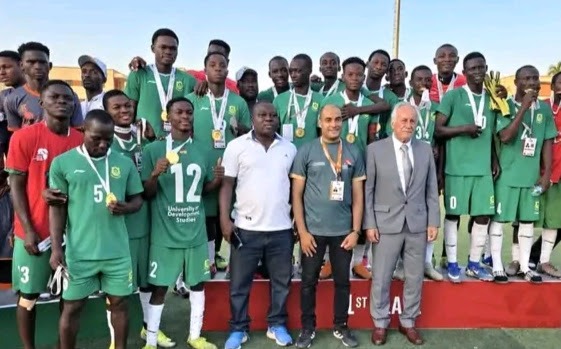
Now, the university has returned to the African stage and is once again challenging for continental honours.
The defending champions have reached the final of the 2026 All Africa University Games in Cairo, continuing a remarkable run of international success.
At this point, however, the conversation should extend beyond the trophies UDS is winning.
The Ghana Football Association (GFA) should take notice.
This is not a call for every UDS player to be automatically selected for a national team. It is a call for proper scouting and assessment.
The players deserve to be watched and evaluated on their individual merits, including their technical ability, tactical understanding, physical qualities, decision-making, positional discipline, consistency and ability to perform against international opposition.
The coach and technical team also deserve attention.
Repeated success at the international level requires more than talented players. It requires preparation, organisation, tactical understanding, discipline and effective coaching.
There may be players within the UDS team who can progress into Ghana’s professional football system. Others may require further development. There may also be coaching and technical expertise within the UDS setup from which Ghanaian football can learn.
The important thing is that they should be properly identified, assessed and monitored.
GFA, the Talent May Already Be in Front of You Ghana’s football talent-identification system should not be restricted to traditional professional football pathways.
Universities are also producing footballers
UDS has provided an extraordinary example of what can happen when education, discipline, coaching and sporting opportunity come together.
This is a university that was established in Northern Ghana with a mission of “Knowledge for Service.”
It developed an educational philosophy that takes students beyond the classroom.
It created a distinctive Third Trimester Field Practical Programme that takes learning into communities.
And now its students are taking the name of Ghana beyond our borders and competing successfully against universities from across Africa and the world.
That is a story worth paying attention to.
So, to the Ghana Football Association:
Watch UDS.
Watch the players.
Watch the coach.
Watch the technical team.
Study their development.
Give deserving players opportunities to demonstrate what they can do at higher levels.
Ghana should not wait until another club or another country discovers talent that has already been competing under the Ghanaian flag.
UDS has distinguished itself academically.
It has distinguished itself through community engagement.
It has distinguished itself through its unique approach to practical education.
And now, it is distinguishing itself in sport.
From the classrooms and communities of Northern Ghana to the football fields of Africa and the world, the University for Development Studies continues to write a remarkable Ghanaian story.
Congratulations to the players, coach, technical team, management and the entire UDS community.
UDS has carried the name of Ghana with pride. Now, the talent behind those achievements deserves a closer look.
Source: Curtice Dumevor, Public Health Expert and Social Commentator
About Author