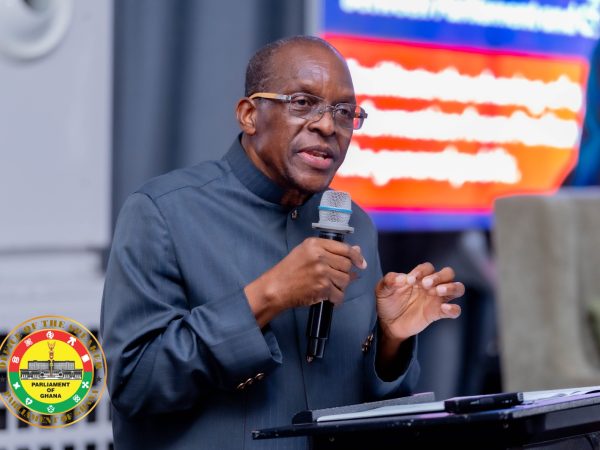

Minority Chief Whip of Parliament calls for Legislation to Criminalize ‘Ecocide’ to Combat Environmental Devastation

In a decisive push for environmental justice, the Minority Chief Whip and Member of Parliament for Nsawam-Adoagyiri, Frank Annoh-Dompreh, has formally called on Parliament to enact legislation criminalizing “ecocide.”
With a statement on the floor of Parliament on Monday, March 9,2026, the lawmaker warned that the relentless destruction of Ghana’s ecosystems has reached a critical threshold, necessitating a shift from mere regulatory fines to rigorous criminal liability for individuals, corporations, and state actors.
Hon. Annoh-Dompreh defined ecocide as unlawful or reckless acts committed with the full knowledge that they are likely to cause severe, widespread, or long-term environmental damage.
He argued that the current legal framework is insufficient to tackle the scale of devastation caused by deforestation, industrial pollution, and the rampant illegal mining activities known as galamsey.
By making ecocide a standalone crime, the MP believes Ghana can close a “legal vacuum” that currently allows large-scale ecological destruction to occur with minimal consequences.
The call for legislative reform comes at a time when Ghana’s natural resources are under unprecedented strain.
The Minority Chief Whip highlighted alarming data suggesting that up to 60 percent of the nation’s water bodies have been polluted by illegal mining operations.
He stressed that environmental stability is not an abstract concept but the very foundation of food security, public health, and intergenerational economic development.
Hon Annoh-Dompreh further pointed to a growing global movement toward environmental accountability.
While the International Criminal Court currently recognizes genocide, war crimes, and crimes against humanity, ecocide has yet to be formally adopted as a fifth international crime under the Rome Statute.
However, several nations including France, Belgium, Chile, and several Eastern European countries have already integrated ecocide into their domestic penal codes.

Notably, Belgium recently became the first European Union member to do so, a move Hon Annoh-Dompreh urged Ghana to emulate.
To move the agenda forward, the Minority Chief Whip recommended the introduction of a standalone ecocide law with clearly defined damage thresholds, enhanced investigative powers for environmental institutions, and strict penalties including custodial sentences and mandatory environmental restoration.
He also urged the government to take a leadership role on the global stage by championing the recognition of ecocide as an international crime.
The legislation proposal received strong bipartisan support from across the floor.
Hon Charles Akwesi Agbeve, MP for Agotime-Ziope, commended the initiative and noted that the Democratic Republic of the Congo is currently the only African nation to have taken similar legislative steps.
He argued that a specific ecocide law would provide the necessary teeth for enforcement against activities like sand winning and plastic pollution, which continue to degrade the landscape despite existing environmental regulations.
Furthering the debate, the Member of Parliament for Walewale, Dr. Tiah Abdul-Kabiru Mahama, underscored the moral weight of the proposal.
He argued that if the deliberate destruction of human life is a crime, the intentional or negligent destruction of the plant and animal life that sustains humanity should be treated with equal gravity.
Dr. Mahama linked ecological preservation directly to the fight against climate change, citing the rise in flooding and new diseases as direct consequences of environmental neglect.
Source: Felix NYAABA/expressnewsghana.com
About Author