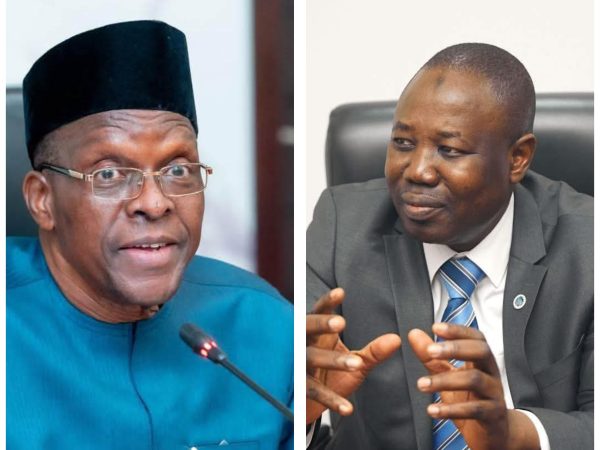


Minority Accuses BoG Governor of Concealing True Losses, Warns of “Policy Insolvency”

The Minority Caucus in Parliament has accused the Governor of the Bank of Ghana, Dr. Johnson Asiama, of concealing the true financial position of the central bank, alleging that the widely reported GH¢15.6 billion loss for 2025 significantly understates the actual figure.
Addressing a press conference in Parliament on Sunday, May 3, Minority Spokesperson on the Economy and Ranking Member of the Economic Committee of Parliament, Hon. Kojo Oppong Nkrumah, claimed that the central bank’s real cumulative loss stands closer to GH¢44 billion.
According to him, “the GH¢15.6 billion being put out is only a fraction of the full picture. When you examine the consolidated accounts and factor in what has been moved into other comprehensive income, the true operating loss is about GH¢34.9 billion, and when you adjust for what we consider artificial revenue, it rises to approximately GH¢44 billion.”
He further alleged that the central bank resorted to what he described as “clever accounting” and one-off asset sales—particularly the sale of gold reserves—to mask a worsening financial position.
“They generated about GH¢9.5 billion from selling nearly half of our gold assets to artificially boost income. Without that, the Bank of Ghana would clearly be in a negative position,” he argued.
The Minority also raised concerns about what it described as a breach of due process under the Bank of Ghana Act, 2002 (Act 612), criticizing last week’s press conference by the governing National Democratic Congress (NDC), where party officials announced details of the central bank’s audited accounts.
“The law is clear,” Oppong Nkrumah stated. “The Bank of Ghana must first submit its audited accounts to the Finance Minister and publish them in the Gazette before they are transmitted to Parliament. It does not permit the accounts to be handed to a political party to announce. What happened was not only irregular but a blatant politicization of the central bank.”
He warned that such actions risk undermining the operational independence and credibility of the central bank.
“If the Governor allows political actors to dictate how the bank complies with the law, it sets a dangerous precedent that could erode institutional integrity,” he added.
A central plank of the Minority’s argument is the claim that the Bank of Ghana has, for the first time, become “policy insolvent”—a condition where it cannot finance its core monetary policy operations from internally generated income.

Citing figures from the bank’s own report, Oppong Nkrumah explained that once proceeds from gold sales are excluded, the bank’s operational income falls short of its sterilization costs, leaving a deficit estimated at about GH¢4 billion.
“This means the central bank cannot sustain its operations without external support or extraordinary measures. That is a serious red flag,” he said.
The Minority also challenged assertions that the losses were the unavoidable cost of stabilizing the economy.
Instead, it blamed what it described as “poor policy choices” by the current management, including the reversal of earlier liquidity management measures and changes to the gold purchase programme.
“They want Ghanaians to believe this is the cost of fighting inflation. It is not. It is the cost of policy reversals and decisions that have proven more expensive than the alternatives they replaced,” Oppong Nkrumah argued.

He further pointed to the impact of the central bank’s operations on the broader economy, claiming that aggressive liquidity sterilization had constrained private sector lending while benefiting commercial banks.
“In 2025 alone, the Bank of Ghana paid over GH¢14 billion in interest to banks. At the same time, credit to the private sector declined, making it harder for businesses and young entrepreneurs to access financing,” he said.
The Minority however cautioned that headline macroeconomic stability figures do not reflect the lived realities of citizens.
“A stable currency without jobs, accessible credit, and a thriving private sector is incomplete stability,” Oppong Nkrumah noted.
He emphasized that the caucus would, in the coming days, propose measures to restore what it describes as “true policy solvency” at the central bank, while urging greater transparency and adherence to statutory procedures in the handling of public financial information.
Source: Felix NYAABA/ expressnewsghana.com
About Author