

Ablakwa Justifies Decision Not to Ratify U.S. Third-Party Deportee Arrangement
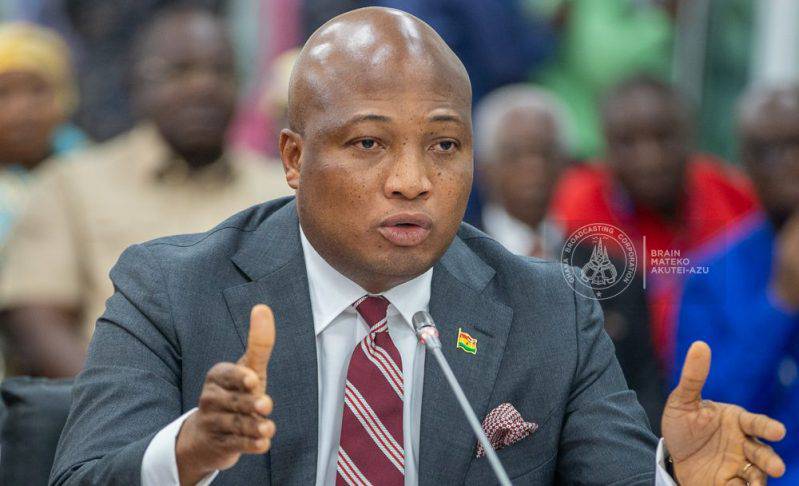
Minister for Foreign Affairs, Samuel Okudzeto Ablakwa, has defended the Mahama administration’s decision not to submit its understanding with the United States on the handling of third-party deportees to Parliament for ratification.
The issue sparked heated exchanges on Wednesday when the Ranking Member of the Foreign Affairs Committee, Samuel Abu Jinapor, pressed the minister for clarity on the legal basis, security implications and national-interest considerations underpinning the arrangement.
Ablakwa insisted the understanding poses no threat to Ghana’s security or sovereignty, explaining that such matters are handled in close collaboration with the country’s security and immigration agencies.
“Such matters are managed in coordination with the appropriate security and immigration agencies to ensure Ghana’s sovereignty, security, and international responsibilities are fully protected,” he said, adding that the government remains committed to maintaining peace and stability.
However, Jinapor questioned why the minister had not sought parliamentary approval under Article 75(2) of the Constitution, referencing the Supreme Court’s ruling in Bamfo v. Attorney-General, which held that even non-binding instruments — including note verbales — require ratification. He accused the government of sidestepping a clear constitutional obligation.
Ablakwa rejected that interpretation, arguing that the arrangement with the U.S. is merely an exchange of notes and not a treaty, and therefore does not fall under the category requiring parliamentary approval.
“It is not a binding agreement. We can walk away from this at any time, and the Attorney-General has advised that such understandings do not require parliamentary ratification,” he said. He warned that subjecting every non-binding diplomatic engagement to parliamentary scrutiny would cripple the country’s foreign policy machinery. “We enter into about 50 MOUs a day. If we were to bring all non-binding instruments to Parliament, it would be impractical.”
Jinapor further asked what benefits Ghana stands to gain from accepting third-party deportees.
Ablakwa responded that the arrangement is driven solely by humanitarian considerations, dismissing claims of financial incentives.
“The Government of Ghana has not requested any monetary, logistical, or material support. This is purely on humanitarian grounds as a Pan-Africanist nation,” he said.
He stressed that the deportees involved are fellow West Africans. “These are fellow West Africans who have been detained and treated poorly. Ghana cannot look on. Ghana is their home. West African nationals do not need visas to enter Ghana and may stay for at least 90 days. So this is in line with regional integration,” he added.
Source: Felix Nyaaba/expressnewsghana.com
About Author